

Christian Manhart, UNESCO Kathmandu
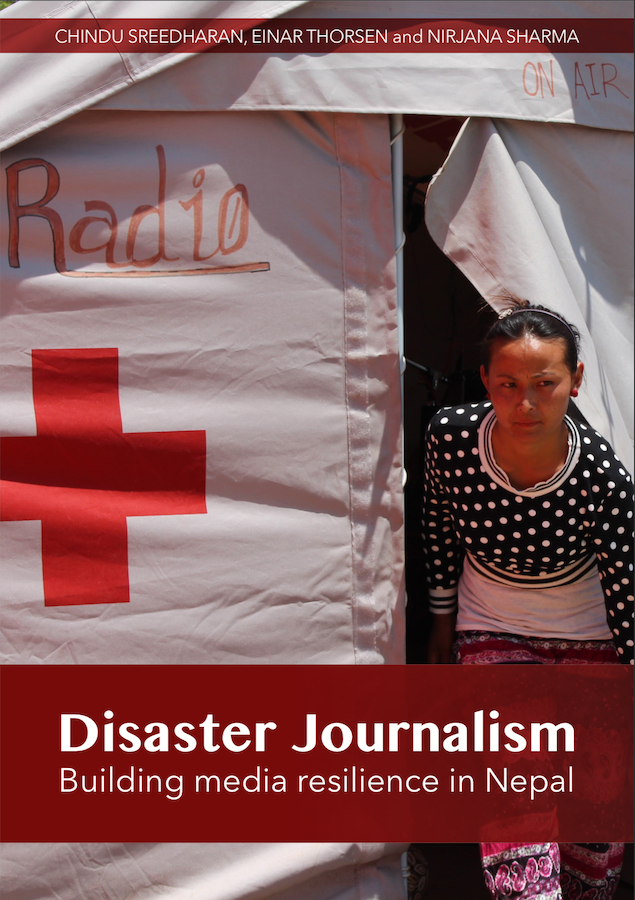
Affected communities need information during disasters. What has happened? What can be expected? Where are the safe places? Who should survivors contact? What should they do? What should they not do?
There are many questions that people need answers for, and the timely dissemination of information is important to save lives, reduce trauma, and facilitate smooth relief and rehabilitation works. Good communication is also required to enhance the relationship among the government, national and international organisations, and the civil society—before, during, and after a disaster. In all this, the news media play a crucial role.
The importance of disaster journalism in Nepal, hence, cannot be overstated. Situated in one of the world’s most disaster-prone areas, the nation is particularly vulnerable to calamities. As the 2015 earthquake showed, it is also ill-prepared. Enhancing the disaster preparedness of news media personnel is therefore of great importance to lessen the impact of future events.
This book, a joint effort between Bournemouth University (UK) and UNESCO Kathmandu, is written with that purpose in mind. Arising out of a larger project to strengthen the disaster communication landscape in Nepal, it seeks to present actionable knowledge and practical solutions to journalists, media educators, and media organisations. In keeping with our objective of reaching a cross-section of Nepali journalists and communicators, this book is bilingual.
The book was launched 16th September 2019 at UNESCO Kathmandu Office, Sanepa, Lalitpur.
 Dr Chindu Sreedharan is Principal Academic in Journalism at Bournemouth University. He is a former journalist and has a particular interest in journalistic storytelling as a means to improve human rights situations and empower marginalised groups. His research focuses on ‘abnormal journalisms’, reportage that extends the boundaries of conventional newswork—from crisis and post-disaster newsgathering, to journalism on social media, as well as emerging forms of nonfictional narratives. He is Co-Principal Investigator for Media Action Against Rape (MAAR). He tweets
  Dr Einar Thorsen is Associate Professor of Journalism and Communication, and Deputy Dean of Research and Professional Practice for the Faculty of Media and Communication at Bournemouth University. His research concerns online journalism, citizens’ voices, and news reporting of crisis and political change—linked with protecting freedom of speech, human rights, and civil liberties—especially for journalists, vulnerable people, marginalised groups, and in contexts or countries where such liberties are being curtailed. He tweets
  Nirjana Sharma is the head of Communication and Information Unit at UNESCO Office in Kathmandu since 2016. She brings to UNESCO her first-hand experience of journalism during many difficult times faced by Nepali media followed by the instability during political crisis, as well as the natural disasters, to design concrete programmes for responding to the need of media development in Nepal. She was a reporter for The Kathmandu Post from 2010 to 2012 and a correspondent at Republica from 2012 to the beginning of 2016. Both the English daily newspapers are published from Kathmandu. She tweets